A philanthropist friend once told me, joyfully, that she had made a five-figure gift to a famous conservation organization. (You would know its name. It raises hundreds of millions of dollars and holds assets of a similar magnitude.)
She knew I would be proud of her. And I was. Very. But something was niggling at me.
At the time, I was working with a vastly smaller African conservation nonprofit. It was lean, ambitious and extraordinarily effective. It was also gasping for funds to pay core staff.
Her gift would have mattered enormously there. But she had never heard of them. And they had almost no way of reaching philanthropists like her.
Now, I am a gal who LOVES a win-win. Trust me on this. Have you seen my registration plates? So when I see this funding pattern again and again, it frustrates me. It made me wonder: Are philanthropists playing too safe by funding only the big organizations they already know?
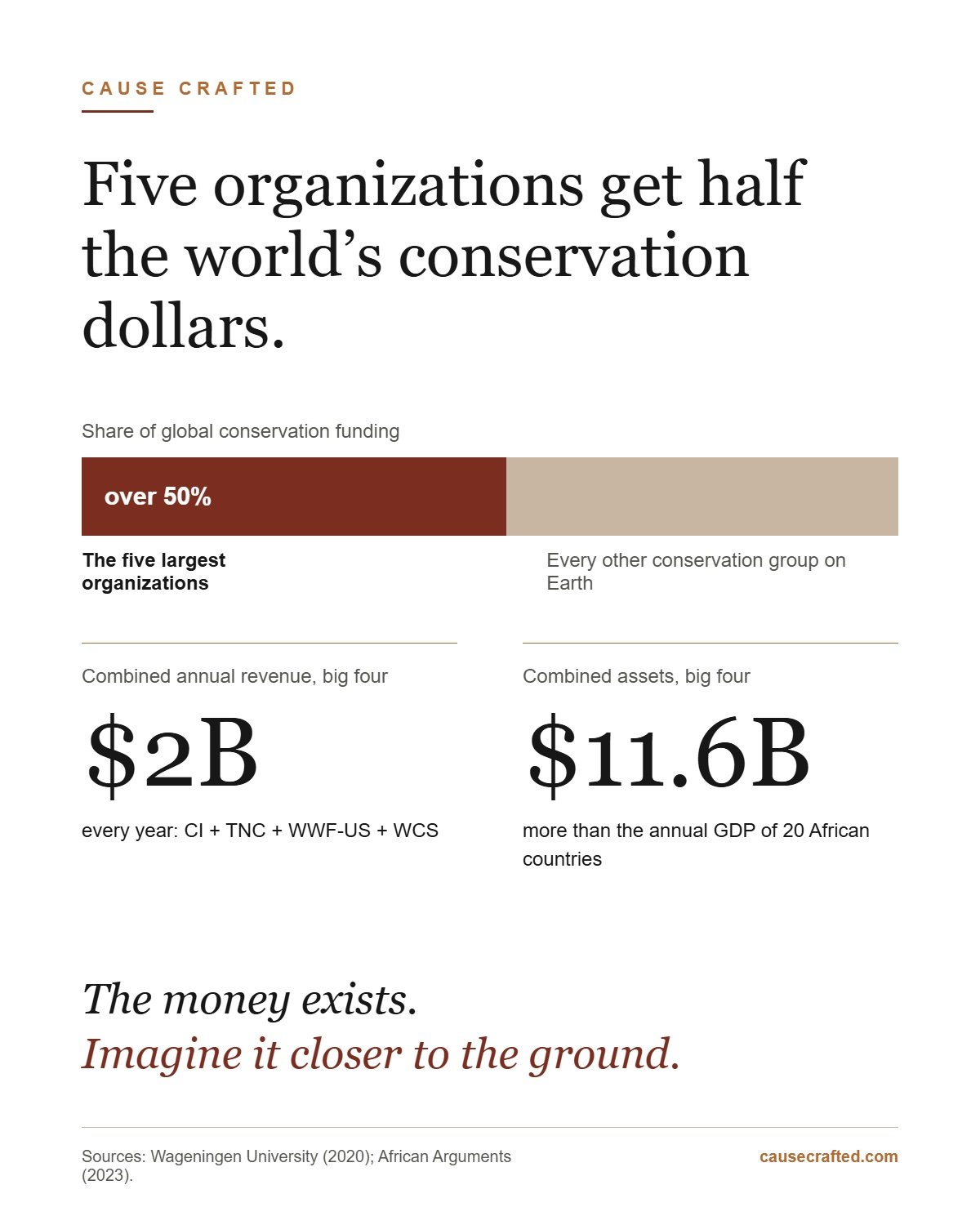
So I started digging. And the numbers shocked me. Research suggests the five largest conservation organizations command more than half of global conservation funding.
Four of the biggest collectively bring in around $2 billion a year and hold more than $11 billion in assets.
Crikey! Why does the money cluster there?
Perhaps because big conservation names feel safe. You know them. They are visible. Easy to research. Professionally presented. Familiar to advisers. There is comfort in knowing that thousands of other donors have already made the same choice.
Let me be clear: none of that makes them a bad place to give. They do exceptional work. And for the right-sized gift, I would happily point a donor toward one of them.
But familiar is not always the same as optimal.
A $50,000 gift may be relatively modest inside a $200 million organization.
In a superb $500,000 or $1 million in-country organization, it might be transformational.
It could hire another ranger. Unlock an entire project. Or launch a needed human-wildlife conflict program. Keep brilliant field staff doing the work they are so good at.
And something else happens. The philanthropist gets to see their gift in action.
I know how deeply satisfying it can be to watch your gift go to work quickly, and to know that what you gave truly mattered.
So no, I am not suggesting we should only “fund small nonprofits.”
I am suggesting something simpler: Fund the organization where your particular gift can do exceptional work.
Sometimes that will be a global giant. Sometimes it will be an organization you have never heard of. Yet.
The money exists. Imagine it closer to the ground.
Imagine it out there within months of your gift, supporting frontline conservationists, protecting precious habitat, solving urgent problems, and saving wildlife.
Now that is where philanthropy starts to feel rather wonderful.
If you’re considering a conservation gift in Africa and would value a few ideas on where to look, message me directly on LinkedIn. I’m happy to help you think through some promising options.